If you have ever tried to plan a Kenya safari, you have almost certainly hit this crossroads. The Masai Mara or Amboseli? Both are world-famous. Both are extraordinary. Both are written about endlessly in travel magazines and wildlife documentaries. And both are completely different experiences, with different landscapes, different wildlife concentrations, different atmospheres, and different strengths. The right answer depends entirely on what you are hoping to find – and on being honest with yourself about what kind of traveller you are.
I have spent time in both parks across different seasons and different years, and I am going to give you my honest, personal comparison – not a list of star ratings or a sanitised overview, but the real texture of what each place feels like and what it genuinely offers. My hope is that by the end of this, the decision feels clear rather than complicated.
The Masai Mara: drama, scale, and the greatest show on earth
The Masai Mara National Reserve sits in southwestern Kenya, bordering Tanzania’s Serengeti, and together they form one of the largest and most celebrated wildlife ecosystems on the planet. The Mara is big, open, and theatrical in the way that only truly vast landscapes can be. The terrain rolls out in front of you in sweeping waves of golden grass, bisected by the winding, murky green ribbon of the Mara River. There is nothing modest about this landscape. Everything here feels expansive – the sky, the horizon, the sheer density and variety of the wildlife.
The park is famous above all else for the Great Migration – the annual movement of over a million wildebeest, zebra, and gazelle between the Serengeti and the Mara, typically peaking between July and October. The river crossings, where thousands of animals plunge into crocodile-filled water in a chaos of splashing and noise and dust, are among the most dramatic natural spectacles anywhere on earth. If you are visiting Kenya between July and October and witnessing the migration is a priority, the Mara is where you need to be. There is nothing else quite like it. For detailed information on migration timing and what to expect, the Magical Kenya website has comprehensive seasonal guides for the Mara.
Beyond the migration, the Mara is exceptional year-round for big cat sightings. Lion prides here are large and well-habituated to vehicles, which means extraordinary close encounters are relatively common compared to less-visited parks. Cheetah are regularly spotted on the open plains, where the short grass gives them their preferred hunting terrain and gives visitors unobstructed views. Leopard sightings, while always a matter of luck and patience, are more frequent here than in many other parks, particularly along the riverine woodland where they favour the shade and the height of the acacia trees.
The Mara is also where you will find the densest concentration of safari camps and lodges in Kenya, ranging from ultra-luxury tented camps with butler service and private plunge pools to more budget-conscious options that still deliver excellent game drives. The trade-off is that it is Kenya’s most visited park, and during peak migration season, vehicle concentrations around popular sightings can be significant.
Amboseli: elephants, Kilimanjaro, and a different kind of quiet
Amboseli is a smaller park – much smaller than the Mara – and it has an entirely different character. Situated in the shadow of Mount Kilimanjaro just north of the Tanzanian border, Amboseli is defined by two things above all others: its elephants and its mountain. The park sits on the dried bed of an ancient lake, and the combination of open dusty plains, swampy wetlands fed by underground springs from Kilimanjaro, and acacia woodlands creates a varied and visually distinctive landscape unlike anywhere else in Kenya.
The elephant population in Amboseli is one of the most studied in the world, and the herds here are large, relaxed, and deeply accustomed to the presence of vehicles. Watching a hundred elephants move across the swampy plains with Kilimanjaro rising in the background – on those clear mornings when the summit is fully visible and dusted with snow against a deep blue sky – is one of the most purely beautiful things Kenya has to offer. It is the kind of view that stops conversation in a vehicle and fills the silence with something that feels very close to reverence.
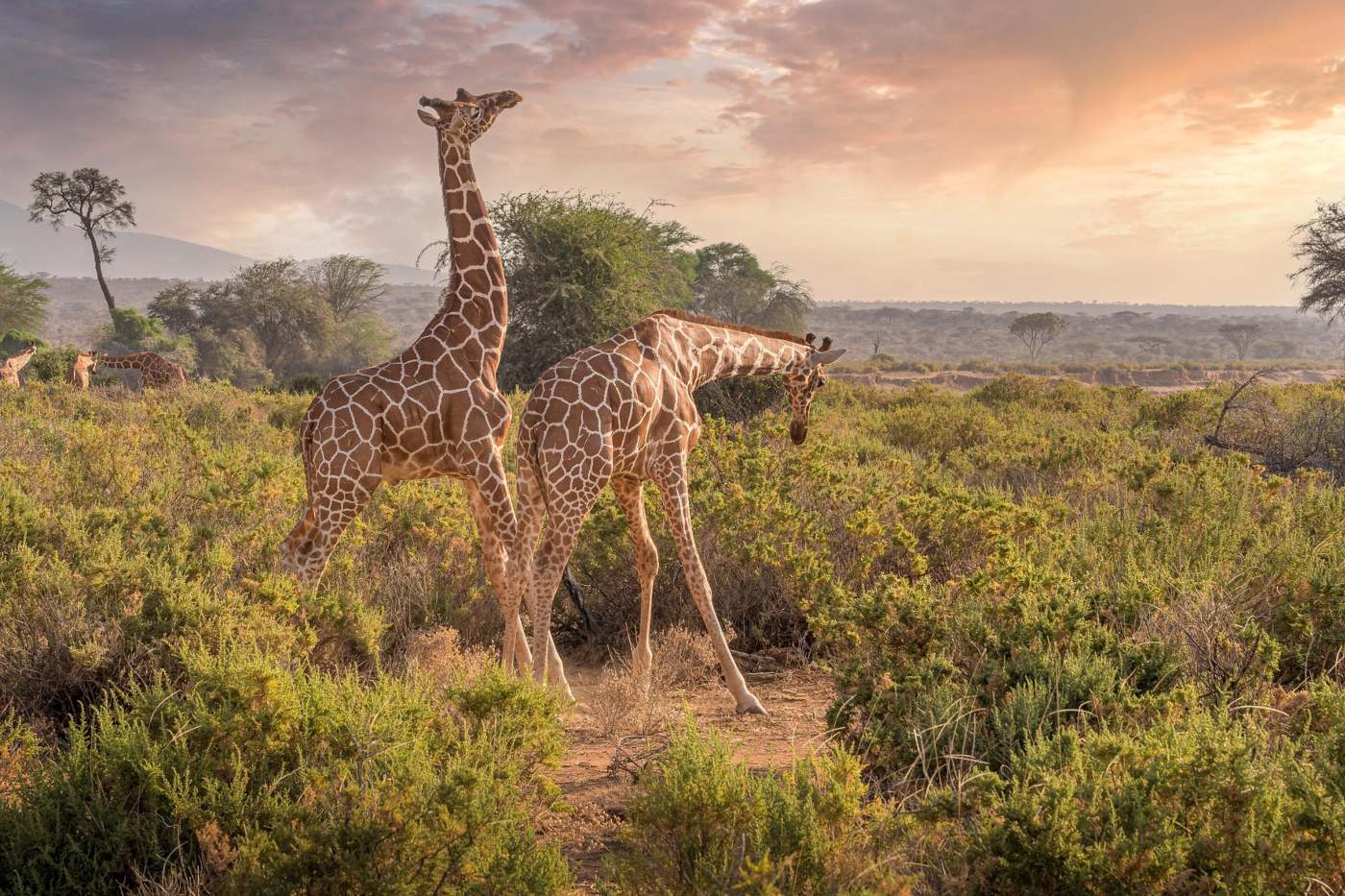
Amboseli is also excellent for lions, buffalo, and giraffe, and the birdlife around the swamps is genuinely remarkable – over 400 species have been recorded in the park. What it lacks compared to the Mara is the sheer density of game across a large area, and the dramatic variety of big cat encounters on open terrain. But what it offers in return – that intimacy, that Kilimanjaro backdrop, those elephants moving in their unhurried, intelligent way – is something the Mara simply cannot replicate.
The practical differences
Beyond the wildlife experience, there are practical differences worth considering. Amboseli is significantly closer to Nairobi – roughly four to five hours by road – making it more accessible for shorter itineraries or travellers who want to minimise time in transit. The Masai Mara is five to seven hours from Nairobi by road, though both parks are well-served by domestic flights that reduce travel time to under an hour.
In terms of cost, both parks require a park entry fee, which can be checked and paid through the Kenya Wildlife Service. Accommodation ranges from budget camping to luxury lodges in both destinations, though the Mara generally offers a wider range of options at every price point. Both parks have strong community conservancy areas around their borders, which often provide quieter, less crowded alternatives to the main reserve while still delivering exceptional wildlife experiences.
So which should you choose?
Choose the Masai Mara if you are visiting between July and October and want to witness the migration, if big cat sightings are your priority, if you want the full cinematic wide-open-savannah Kenya safari experience, or if you simply want the greatest possible variety of wildlife encounters concentrated in one area.
Choose Amboseli if you are a wildlife photographer drawn to that iconic Kilimanjaro backdrop, if elephants are your passion, if you prefer a smaller and less crowded park, if you are visiting outside the migration season, or if you want a more intimate and unhurried experience where the pace feels less driven by sightings and more by the landscape itself.
Choose both if your schedule and budget allow, because together they give you a more complete picture of what Kenya’s wildlife landscape truly offers. Many itineraries successfully combine Amboseli and the Mara in five to seven days, and it is one of the finest safari combinations available anywhere in Africa. You leave with two completely different sets of memories, and that contrast – the vast theatrical Mara against the quiet, elephant-filled floodplains of Amboseli – is itself a kind of education.